
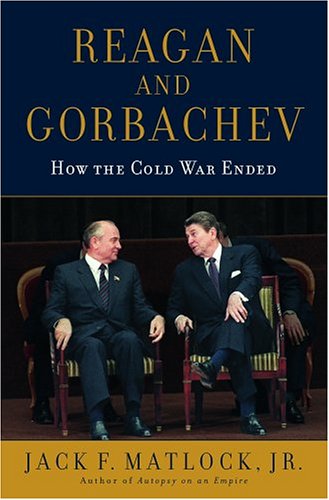
Reagan and Gorbachev:
How the Cold War Ended
by Jack F. Matlock, Jr.

In Reagan and Gorbachev, Jack F. Matlock, Jr., gives an eyewitness account of how the Cold War ended, with humankind declared the winner. As Reagan’s principal adviser on Soviet and European affairs, and later as the U.S. ambassador to the U.S.S.R., Matlock lived history: He was the point person for Reagan’s evolving policy of conciliation toward the Soviet Union. Working from his own papers, recent interviews with major figures, and archival sources both here and abroad, Matlock offers an insider’s perspective on a diplomatic campaign far more sophisticated than previously thought, led by two men of surpassing vision.
“Engrossing …authoritative…a detailed and reliable narrative that future historians will be able to draw on to illuminate on the most dramatic periods in modern history.” Los Angeles Times Book Review
Matlock details how, from the start of his term, Reagan privately pursued improved U.S.—U.S.S.R. relations, while rebuilding America’s military and fighting will in order to confront the Soviet Union while providing bargaining chips. When Gorbachev assumed leadership, however, Reagan and his advisers found a potential partner in the enterprise of peace. At first the two leaders sparred, agreeing on little. Gradually a form of trust emerged, with Gorbachev taking politically risky steps that bore long-term benefits, like the agreement to abolish intermediate-range nuclear missiles and the U.S.S.R.’s significant unilateral troop reductions in 1988.
“Absorbing…The author excels in his descriptions of U.S. policy making, infighting and all, and also in giving the Soviet side of events, basedin part on interviews with Gorbachev and other Kremlin officials.” Business Week
Through his recollections and unparalleled access to the best and latest sources, Matlock describes Reagan’s and Gorbachev’s initial views of each other. We learn how the two prepared for their meetings; we discover that Reagan occasionally wrote to Gorbachev in his own hand, both to personalize the correspondence and to prevent nit-picking by hard-liners in his administration. We also see how the two men were pushed closer together by the unlikeliest characters (Senator Ted Kennedy and François Mitterrand among them) and by the two leaders’ remarkable foreign ministers, George Shultz and Eduard Shevardnadze.
“[Matlock’s] account of Reagan’s achievement as the nation’s diplomat in chief is a public service as well as a contribution to the historical record….It is also corrective, since it debunks much of the hype and spin. … The truth is a better tribute to Reagan than the myth.” Strobe Talbott, The New York Times Book Review
The end of the Cold War is a key event in modern history, one that demanded bold individuals and decisive action. Both epic and intimate, Reagan and Gorbachev will be the standard reference, a work that is critical to our understanding of the present and the past.
Translations
 Russian edition |
 Latvian edition |
 Danish edition |
Questions Welcome
Questions and comments are welcome from registered participants who have read the book. (I don’t have time to explain again something I have explained in the book.)
Jack. I’m surprised no one has commented on this book yet. Allow me to be the first. I’d like to read that book someday, shame there aren’t any audio formats of your books. Your jerney in the diplomatic field has inspired me to work in international relations my self someday. I admire you as well as other US and Soviet/Russian foreign officials, from Kissinger, Dobrynin, to the Georgian who was Gorbachev’s Secretary of State who’s name I can’t spell. Did you ever have any trouble working with US officials at all during your time as a diplomat?
I am not sure what you mean by “trouble.” We sometimes had differences of opinion in the administration, but that is usually the case in policy making. Big mistakes can be made when there is too much uniformity of thinking. I describe some of the differences in Reagan and Gorbachev . For example, my advice regarding our response to Nick Daniloff’s arrest was different from the policy the State Department followed. So, yes, there were differences, but I would not describe policy disputes as “trouble” unless they become become personal. Debating policy before decisions are made is part of the job, but everyone should be prepared to carry out the president’s decision once it is made.
Jack, do you agree with me when I believe Gorbachev and Medvedev have much in common? ex-lawyers now in politics, and the youngist leaders in office at their peaks of power. Gorbachev was only 54 when he became Soviet leader, and Dmitry Anatolyivich is 44 now.
I’m not sure there is that much similarity. Yes, they are both younger than their predecessors and both were trained in the law, but their style of governance is quite different since the government of the systems they ruled are quite different. Gorbachev rose in the ranks of the Communist Party to become its boss, and used that power to change the system. Medvedev has much less power. He clearly shares it with former president, and current prime minister, Vladimir Putin, and neither is able to exercise the sort of authority the general secretary of the Communist Party could when Gorbachev occupied that office.
So far as his rhetoric is concerned, Medvedev talks about reform more than Putin and repeatedly criticises corruption and the like. But then very little is done. Maybe this is a sign of the limits on his power; it also could be a sign that he is not serious.
Bottom line: Gorbachev did infinitely more to change the system he inherited than Medvedev has done, but the systems are quite different. Many of the freedoms Gorbachev established (such as the freedom to travel and freedom of speech) are still in place. So Russia is not in a need to reform to the same degree the Soviet Union was when Gorbachev came to power in 1985.
Jack. I’m curious. When did you first meet Mikhail Gorbachev, and what were your impressions of him then? Also, did you ever meet Anatoly Dobrinin when you were US ambassador in the Soviet Union?
I first met Gorbachev in 1985, shortly after he became General Secretary of the Communist Party of the Soviet Union (the most powerful Soviet leader). He struck me as vigorous, smart, and quite self-assured. At the time, he still felt that the Communist Party could lead reform in the Soviet Union. He changed his mind later when he ran into opposition to the reforms he considered necessary.
Of course I knew Dobrynin very well. We dealt with him for many years in Washington, where I was at various times director of Soviet Union affairs in the State Department and later special assistant to the president for national security. After I became ambassador I dealt with Dobrynin in Moscow when he returned from Washington to head the Communist Party’s International Affairs Department.
His memoirs are well worth reading, and you will find comments about him in my books.
Jack. I’ve read Dobrynin’s memoirs, very impressive. The guy served as Soviet ambassador to six US Presidents. Anatoly Fyodorivich was one of the best diplomats the Soviet Union had. Shame to hear he past away a few months ago.
Yes, he was a very effective diplomat from the Soviet point of view. But it was a mistake for Kissinger and Nixon to use him as a sole “channel” to the Soviet government. He did not always understand U.S. policies and sometimes (wittingly or unwittingly) misrepresented them to his government. Also, his English was not as good as he thought and he didn’t always get the full meaning of a message if no interpreter was present–and usually there was none.
Which of the two men, Reagan or Gorbachev, do you feel began ending the Cold War?
Reagan’s policy, set forth in his January 1984 speech, established a viable framework of negotiating an end to the Cold War. But other Soviet leaders would not have accepted it. It took both Reagan and Gorbachev to make it work.
I see. It’s a shame Gorbachev’s policies had the kind of drawbacks they did, including a lot of opposition.
Initially, Gorbachev’s policies did not have a lot of opposition. Even the military supported some of the efforts to end the arms race. The opposition occurred when he began to reform the system internally.
By internaly you mean when he created the office of Soviet President and got the Congress of People’s Deputies back?
I mean when he began, by a variety of means, including the contested elections in 1989, to reduce the monopoly power of the Communist Party.
What was your opinion on meeting various Soviet military figures, like Yazov or the Soviet Chairman of the Joint Chiefs of Staff, or Boris Nikolayivich Yeltsin?
The military contacts were very useful once they got started. Admiral Crowe, then Chairman of the Joint Chiefs, developed a good relationship with Marshal Akhromeyev, and then General Powell continued the contacts.
Speaking of Powell, I’m surprised Bush 43 picked him as Secretary of State. With his military carrer, I think he’d be more suited for Secretary of Defence. Reagan and Gorbachev couldn’t have been more different. Regan a former actor and Governer of California, and Mikhail Sergeyevich, a former attorney and agruculture Secretary.
Powell was an excellent Secretary of State but Bush ignored his advice. Incredible that Bush let amateurs take us to war when he had Powell in his cabinet–who advised against it.
Gorbachev was never an attorney, although he studied in the law faculty. From the university he went right into full-time Communist Party work, first in the Komsomol, then as provincial Party secretary. His specialty was agriculture since Stavropol was an agricultural area. When he was transferred to Moscow, he was put in charge of agriculture in the CPSU CC Secretariat.
My mistake. Another person in Bush 43’s cabinet I liked was the first woman and first African-American National Security Advisor, and First African-American Secretary of State. If she decides to ever run for the Presidency, she’d have a good foreign policy resume.
Yes, Condoleeza Rice is a fine person. But as National Security adviser she dropped the ball–we could have prevented 9/11. And she failed to support Colin Powell when he was secretary of state and was advising on more sensible policies than those Bush and Cheney wanted. But she is quite able, and I am sure has learned a lot from her experiences in the Bush-Cheney administration. She did improve policies when she was secretary of state. Her memoirs are quite interesting.
If Regan were stil alive today, I doubt he’d like the kind of foreign policies we’ve used after the Cold War ended.
Jack, thank you very much for this informative work. Would you mind elaborating on Reagan’s decision at Reykjavik for turning down the package deal? Do you think he fully understood the current state of SDI research? Thanks again for all you’ve done.
He had been told by Weinberger and others that if he agreed not to test SDI it would “kill” the program. Therefore, he considered Gorbachev’s demand to keep SDI research in laboratories for ten years a ploy to kill the program. Also, Gorbachev flatly refused his offer to eliminate all U.S. and Soviet ballistic missiles before strategic defenses could be deployed.
Reagan was willing to agree on INF and the 50% reduction of strategic missiles over five years, but it was Gorbachev that insisted on a package deal including the limitation of SDI research to laboratories.
Actually, limiting the research to laboratories would not have killed the program. When we returned from Reykjavik, Admiral Poindexter was prepared to recommend to Reagan that we agree to confine SDI research to laboratories for eight years , and also ordered a study of variants to the proposal for the second five years of a ten-year period. Unfortunately, he was forced to resign over Iran-Contra before we could get approval to go ahead, and the whole Iran-Contra scandal immobolized the Reagan administration for several months. Without it, we very likely could have obtained a START agreement in 1988 rather than waiting until 1991.
Jack,
I just finished reading Reagan and Gorbachev. It was a brilliant work that clarified a lot of questions I had about the nature of the Reagan/Gorbachev relationship. I’ve now moved on to the memoirs of George Shultz and Pavel Palazhchenko. In Palazchenko’s memoirs, he says that the initial reaction to Star Wars in the Soviet Union was “not done in a reasoned and careful way but in a tone approaching hysteria” (My Years with Gorbachev and Shevardnadze: The Memoir of a Soviet Interpreter, 41). However, how grounded in reason were Gorbachev’s suspicions of SDI as space weapons? I must say that I’m a 21 year old college student and my knowledge of the Cold War is somewhat slim. I grew up at a time when I was too young to know what was going on at the end of it.
My knowledge of the end of the Cold War, I mean to say.
I don’t believe Gorbachev’s concern about SDI as “space weapons” that could be used against earth targets was valid. However, his point that deploying missile defense against strategic weapons while a country had strategic nuclear weapons could be destabilizing was a valid point. Reagan tried to explain that he wished to eliminate all strategic nuclear missiles before strategic defenses were deployed–assuming they proved feasible. Gorbachev refused to accept this approach at their Reykjavik summit in 1986.
This is still a relevant issue. It is one of the concerns that Russia currently has regarding the U.S. missile defense plans. Although the current plans for deployments in Europe would not be effective against Russian strategic missiles, the Russians fear that the defenses could be subsequently developed to have that capacity.
Congratulations on reading Shultz’s memoirs and Palazchenko’s book. Both are excellent. For another Russian point of view, check out Anatoly Chernyaev’s “My Six Years with Gorbachev,” and also Gorbachev’s memoirs.
I see. It is crazy to think how difficult it must have been not only for the two to establish a feeling of trust, but also to maneuver in a way that would be acceptable to their constituents. The fact that each had to worry about the opinions of so many others limited their room to move severely. I understand that Gorbachev could not leave Reykjavik having allowed SDI to pass because having allowed the United States to develop and deploy SDI would have made him look like a huge fool to his nation, since it would have possibly given America “first-strike capability” (theoretically). For me, Reykjavik is by far the most fascinating summit. Even the description of the foreboding atmosphere of heavy rain and constant darkness captures the dramatic aspect of what a summit like this must have been like. Thank God for these two bold men! Anyways, thank you very much for answering my question!
Actually, keeping SDI research in laboratories for ten years, as Gorbachev demanded at Rejkyavik, would not have killed it. But Reagan had been told that it would. Also Reagan had offered Gorbachev a commitment not to deploy SDI unless and until all U.S. and Soviet strategic nuclear weapons had been destroyed. He even offered to eliminate all ballistic missiles before SDI deployment, and to share the defensive system with the USSR, if this were done. Gorbachev did not believe him, which is unfortunate, because Reagan was serious.
I’ll have to find a copy of this book. In fact, I’ll have to try to find copies of all your books if I can. You’re one of my favorite diplomats. On writing Reagan and Gorbachev, what would you say was your favorite sections to write about?
All of mine are available at Amazon.com. Just click on the tab below the image of the book. The others mentioned are also listed by Amazon.com.
As for Reagan and Gorbachev, all the chapters were fun to write, but clarifying what happened at the Reykjavik Summit may have been the most important. Also, writing about Gorbachev’s reaction to Reagan’s proposals, based on Chernyayev’s notes and my interviews with the people involved was rewarding. (The memoirs of other Americans, though very important and interesting, did not have access to Soviet records or, for the most part, to interviews with the top Soviet officials.)
I know Yeltsin and Gorbachev disliked each other very much. What were your impressions of Yeltsin when you met him?
I describe this in detail in my Autopsy on an Empire, from page 111. He made the impression as a true reformer willing to be totally frank in his discussions, unlike other Soviet officials. (This was in 1987. He was then in charge of the Communist Party organization in Moscow.)
You wouldn’t happen to have any funny storeis about things that happened during your ambassadorship to the USSR, would you?
Oh, there are a lot of them. But I don’t have time to recount just now. OK, just one:
Rebecca was greeting Soviet officials at a reception to mark the 200th anniversary of the Constitution (1989). The Soviet Chief of Protocol enters and remarks, “You are so young!”
Rebecca said, “Well, thank you for the compliment, but not really!”
He replied, “Oh, I don’t mean you; I mean your country!”
LOL. I’m sure you recount others in your books. Have you read Gorbachev’s memoris?
Yes. His formal memoirs were published in Russian and English in the 1990s. The English version is edited and reduced from the two-volume Russian. The German translation, however, is complete, and unlike the Russian edition, has a detailed index that is most useful. I have read from all three versions.
Just last year another volume of personal memoirs was published in Russian with the title All Alone, By Myself. It is very interesting but not as candid as one would hope. But it does describe in moving terms the important place his wife Raisa had in his life and his work.
Dear Jack,
I would like to thank you for responding to my last post and let you know that I really appreciate the privilege of being able to hear from you. I’m a student at the University of Virginia majoring in history and philosophy, and your book really sparked my interest in Russia. After reading it, I signed up for a class this semester on Russian history and culture. It’s great stuff! Right now we’re looking at the Magnitsky/anti-Magnitsky laws being passed. I was wondering what your opinion on the so-called “tit-for-tat” exchange was. Are the Russians justified in feeling that this is a smack in their face? Should we take action against the corruption seen in the Magnitsky case? I’ve read some articles saying that there are feelings reminiscent of the Cold War. Having read your book, I was wondering what an expert like you would say on the matter! Anyways, thanks again for answering my questions before and I hope to hear from you soon!
You are lucky to be at UVA which has great courses for the study of Russia. If you see Professor Allen Lynch, give him my warm regards. His book on President Putin is a must for anyone who wants to understand Russia today.
As for the Magnitsky Act and the Russian actions that followed it, they remind me of school kids shouting imprecations in the schoolyard. Except that now, the fallout affects innocent people. It is not a way to solve the underlying problem, which is the corruption of many elements of the Russian bureaucracy, including law enforcement.
I do not argue that the treatment of Magnitsky was not a serious scandal. But it was a Russian scandal (despite the tangential involvement of an American) and Russians, like everybody else, don’t like other people minding their business. It is quite reasonable for the U.S. to refuse visas to persons involved (something that did not require legislation and in fact was being done before the legislation passed) but quite another thing to pass a law requiring that that be done. That set up a direct confrontation that actually reduced Russian government incentive to deal with the problem.
The Russian reaction is one that is going to cause greater damage to Russians than to Americans, particularly to the orphans who will not be able to find loving homes. It does very little damage to U.S. interests, so one may ask, why would the Russian government in effect shoot itself in the foot? The answer is that it is an important element of human psychology to respond to something considered an insult with an insult in turn. When you have a regime that needs the image of an external enemy to justify authoritarian rule, there is an incentive to make the most of any perceived insult even if it is nothing more than a statement of the truth.
President Reagan understood that the best way to increase respect for human rights was by private diplomacy. He noted in his diary early in his presidency that we had been “too up front” in our human rights policy and needed to refocus on private channels. He also recast our comments to avoid direct demands on the Soviet government to do something but instead sought to establish a dialogue over how we could cooperate to improve respect for human rights. When Foreign Minister Shevardnadze asked Secretary of State Shultz, in their first private meeting, if he could raise questions about race relations and the status of women in the United States, Shultz replied, “Be my guest.” He added that he thought we were making progress but we still had a way to go and could use all the help we could get. This attitude eventually brought about private negotiations that emptied the Soviet prisons of political prisoners, established freedom of emigration, and encouraged a relaxation and eventual end of press censorship.
How should we have handled the Magnitsky case? We should have notified the Foreign Ministry privately, without publicity, that until the case was clarified, visas would not be issued to the people involved and that we would assist the Soviet government in its investigation by identifying any international movement of funds by the persons involved, their relatives and associates. But not a peep publicly. This would give the government a chance to bring the culprits to justice and take the credit for it. The guilty might still not be touched if their connections were so high as to give them immunity, but it would maximize the Russian government’s incentive to do something.
There is another aspect of this. The Magnitsky Act was sold in part as a replacement for Jackson-Vanik, an amendment to the 1972 Trade Act that denied most-favored-nation status (equal trading rights) to non-market-economy countries (meaning Communist countries) that deny or restrict the right of their citizens to emigrate. The Soviet Union stopped forbidding travel abroad and emigration in its last year and the restrictions of Jackson-Vanik should have been lifted at that time. Once the Russian Federation became a market economy in the 1990s, there was no legal reason to apply Jackson-Vanik, even if Russia had restricted emigration, which in fact it did not. However, important elements in the U.S. Congress used Jackson-Vanik to pressure Russia on unrelated trade issues.
This was a case not just of moving the goal posts, but of picking them up, putting them in a truck, and saying “We’ll decide later where they belong. Meanwhile, you must move the ball another ten yards and we’ll think about it.” Not very persuasive. And it makes future demands and red-lines must less effective.
Finally, as an American, I find it outrageous that a Congress that cannot pass a budget, that threatens the nation’s creditworthiness by playing political games with the debt ceiling, that has a confidence rating among our public in the single digits, would presume to teach other countries the elements of democracy. The State Department wanted to deal with this issue privately, but Congress refused to “lift” Jackson-Vanik (even though logically and legally it did not even apply to Russia) without the Magnitsky Act. Both sides are acting like headstrong juveniles, but in this case I would specify that the “sides” are the U.S. Congress, not the Obama Administration vs. the Putin Kremlin, which controls the State Duma.
Jack,
I’ve never had Professor Lynch but I’ve heard great things. If I see him I’ll tell him you said hello. This explanation highlights one of the aspects that I, and I think a lot of people, missed at first glance. When I first heard about the legislation, I didn’t realize what the impact of actually making it a national law was. I just thought that this was a rudimentary step in banning those officials associated with the abuse. However, my professor explained that, like you said, making it a law monumentalizes our reaction publicly. I understand now why it was labeled a “performance in the theatre of the absurd.” Like you said, we definitely need to do something about such a serious scandal, but it could have been done in a better, more private fashion. It’s exactly like children shouting at each other across a schoolyard. Hopefully in the future we will work with Russia on their corruption problems, but in a more private, friendly manner rather than this insulting, antagonistic one. A negative tone in our relationship with Russia affects not only Russian orphans and American and Russian citizens, but in many ways can be felt worldwide.
Obviously you have a great professor because it seems that she or he agree with me, on one point at least!
Dear Ambassador Matlock,
Thank you very much for this tremendous memoir which was a great pleasure and a great education to read!
One revelation was your disclosure of the memorandum Reagan dictated to his secretary prior to the first meeting in Geneva, which was more emphatic evidence of Reagan’s independent judgement and decision-making than anything in James Mann’s book The Rebellion of Ronald Reagan which attempts to place particular emphasis on Reagan’s autonomy.
I would like to talk with you about your characterisation of Reagan’s ‘transparency of intent’ and being ‘without guile.’ One can see that the values Reagan espoused genuinely were the ones he cared about and he really did care about individual people’s well being rather than being content to deal with them as a geopolitical abstraction.
James Mann’s conclusion quotes Nancy Reagan using those same words ‘without guile’ to describe her husband, but then challenges this interpretation, quite persuasively it seems to me, highlighting his continuation of hostile rhetoric in the run-up to Congress’ passing of the INF Treaty in contrast to his renunciation of the ‘evil empire’ characterisation when he was in Moscow, and suggesting how the ongoing dialogue with Gorbachev allowed him to continue to voice humanitarian concerns without creating excessive hostility in relations, and also describing a CIA program of covert sabotage against the USSR. Your book provides first hand evidence of how he was willing ‘not to crow’ to achieve humanitarian objectives.
The PBS American Experience documentary on Reagan shows his son Ronald Prescott Reagan (at 8 mins 20 secs) say that his father had few close friends… …if fact no close friends.’ May it not also be that – whilst he spoke from his heart about his values and humanitarian concerns, he was also an extremely private person, and perhaps after the end of his first marriage, was afraid of sharing strategic calculations with anyone unless absolutely necessary?
Thank you very much and best wishes,
Matthew from London, the UK.
Thank you, Matthew, for your comments on my book. You raise some important questions.
But first I should clarify one detail that I got wrong in the book: Reagan did not dictate the comments I quoted to a secretary but wrote them out on a yellow legal pad. I was shown a typed version that he had corrected and assumed it had been dictated. I learned only later, when I read in Edmund Morris’s Dutch: A Memoir of Ronald Reagan a quotation from handwritten notes which I had seen only after they were typed and corrected (pages 543-544). What Morris quoted, however, did not contain the corrections Reagan made on the typed version.
The more important question, though, is the one you raise. I believe that Reagan was totally without guile and dealt with others in a straightforward manner. I think his son goes too far when he said that his father had no friends. Certainly Nancy Reagan was one and the Reagans had others, including notably the Thatchers. Athough Reagan and Margaret Thatcher did not agree on everything, they were personal friends who seemed to enjoy each other’s company. What is true is that Reagan kept everyone, except probably Nancy, at a certain emotional distance. He did not totally bare his soul to others, including his children, but that does not mean he didn’t have friends.
I think Ron’s comment may be a reaction to Edmund Morris’s presumption in making an imaginary friend of Reagan’s the narrator of his biography. There was no person in the position of Morris’s narrator and I believe the Reagan family resented the use Morris made of this device in his biography.
I have not read the book by James Mann that you quote, but I do not believe there is evidence that Reagan acted disingenuously. Many Soviet policies were genuinely threatening and calling attention to them should not be dismissed as “hostile rhetoric.” Reagan said nothing in public that he did not say in private to Gorbachev, so where is the guile? Should he have ignored the Berlin Wall? If so, he would have been accused of going soft on the Soviet Union and it would have been more difficult to get the INF Treaty approved by the Senate. As for any “CIA program of covert sabotage agains the Soviet Union,” I don’t know what evidence Mann could have for that. I believe I was informed of all CIA activities in the USSR and none, at that time, were directed at sabotage or at weakening the Soviet Union. We didn’t even have any agents in the Soviet Union after around 1986. Even when we did, they were not sabateurs but informants. And, as we learned much later, all were betrayed by Aldrich Ames in the CIA and Robert Hanssen in the FBI. So, if Mann argues that Reagan was duplicitous, I would take strong issue with that.
When you first met Gorbeachev’s Scretary of State Shevardnadze, what wre your impressions of him?
Eduard Shevardnadze made a very favorable impression. He was very polite, had a sense of humor and a manner quite different from that of his predecessor, Andrei Gromyko, who had the deserved reputation of being “Mr. Nyet.” His approach throughout was “Let’s reason together and see if we can’t solve these problems.”
I be you wrere sad tosee him resign his post when he did. I’d imagine he got alogn quite well with Reagan’s foreign minister and other members of Us deligations.
He got along well with both Shultz and Baker, as well as Reagan and Bush Sr. When he resigned in December, 1990, he warned that “a dictatorship is coming!” He had in mind a coup against Gorbachev, which in fact happened in August, 1991, but failed. Nevertheless, it so weakened Gorbachev and the Soviet government that Yeltsin and the leaders of Belarus and Ukraine were able to destroy the Soviet Union.
I heard the summet you and the others were in Multa had is’t problems, he weather mostly.
Yes, the weather made the sea rough, so there was no meeting on the U.S. Naval ship that was anchored off shore. Instead, all meetings were on a Soviet passenger ship (the Maxim Gorky) that was at dock and thus did not toss around so much.
From what I’ve read on the summet that year, the Soviets ahs a larger deligation then you did by several members.
I’m not sure. I didn’t do a count, but usually the same number on each side participated in the meetings. We send such large groups of people to summits–most of whom do not attend the meetings–that it would surprise me if the Soviets sent more. They would certainly try to send as many. They were very much psyched on the appearance of equality in all respects.
Turns out I goofed. I read up on the Malta Summet and the American deligation was actualy larger, they had ten people, and Gorbachev’s other people wre only five others.
Dear Ambassador Matlock,
Thank you very much for your response to my question, and please excuse the tardiness of this message!
Mann’s mention of CIA covert sabotage is only passing, peripheral, and qualified as ‘reported’ but refers to the counterintelligence operations responding to the Farewell Dossier, which had indeed ended back in 1984. He references ‘At the Abyss: An Insider’s History of the Cold War’ by Thomas C. Reed (p.266-270), who was apparently a Special Assistant to President Reagan for National Security Policy. Did you known this man? Apparently the operation was kept secret from “pragmatists” such as Chief of Staff Jim Baker and even the president’s wife.
For anyone interested, this wikipedia page has lots of good links on the episode:
http://en.wikipedia.org/wiki/Farewell_Dossier
After reading your response, I thought I better check the definition of the word guile in the online dictionaries: Oxford gives ‘sly or cunning intelligence;’ Cambridge gives ‘clever but sometimes dishonest behaviour that you use to deceive someone.’
You therefore appropriately asked “where’s the deception”; but I’m not sure whether or not that is what I meant about Reagan…
He certainly seems to have expressed an unusually wide spectrum of sentiments. Who else believes in both evil and in a vision of complete nuclear disarmament? And it seems quite natural for one to tend to preclude the other in the minds of decisionmakers. But does not give as much leverage in negotiation.
You say that he wouldn’t have said anything in public that he wouldn’t have said in private, but he would have say in private things that he wouldn’t have said in public, wouldn’t he?
The memorandum for example he certainly seems to selective about what he said, and with very good reasons for doing so. Regarding the emotional distance you describe, his first term counterintelligence operations suggests layers of privacy, as perhaps every astute political leader has.
I believe that the essential transparency of President Reagan to be true, or at the very least unfalsifiable, in the diplomatic relations which are the focus of your book. You clearly demonstrate his relative consistency.
But, although I must concede that I have not read the speeches in question, Mann’s book seemed persuasive in describing a dissonance between the tone of Reagan’s campaign for congressional ratification of the INF Treaty and that of his visit to Moscow. But it is a dissonance which could be for the great benefit of mankind. George HW Bush’s memoir describes how both he and Gorbachev would warn one another not to take forthcoming statements that were addressed to a domestic audience. Do you reject such a characterisation of Reagan?
Anyway, I have another question for you which is more important to me.
I am finishing a short review of key members of the George W Bush administration’s references to Reagan in their memoirs in relation to their accounts of the North Korean nuclear crisis. I basically believe that in their notion of Reagan, they overemphasise candour and overlook his empathy which I believe was more fundamental (influenced very much by your memoir).
Do you have any comment or conjecture on how you think Reagan may have addressed the North Korean nuclear crisis differently?
Thank you very much, and with best wishes,
Matthew, London, UK
Let me take the last one first. I have no idea how Reagan would have handled the North Korean problem and I don’t believe anybody else does. It is (so far, fortunately) unique in many respects. Presumably he would have received the same advice as that given Clinton, Bush II, and Obama that a military strike could be disastrous. For starters, North Korean artillery could take out Seoul before we could take out the artillery. A few years ago, George Shultz said at a meeting in Princeton that he would bring the Chinese into the effort and increase their incentives to control their wards. (That was before the six-party talks, which was following his advice.) It obviously hasn’t worked yet, but if there is to be a solution it is likely to depend more on Chinese action than any other factor. Therefore, it must be considered in the overall context of U.S.-Chinese relations. So far, the elements of growing military friction in the relationship do not bode well. My only thought is that Reagan might have been more amenable than his successors to advice to seek the sort of broad strategic understanding with the Chinese that we eventually developed with Gorbachev.
As for the earlier questions, I would not consider a program to feed false information to Soviet spies tantamount to an effort to bring down the Soviet Union. I was not aware of the program you named because it was operative before I joined the NSC. If I was informed about it, I have forgotten. Certainly I would not have objected to feeding false information as a way of deterring espionage of technical secrets. It probably happened earlier, but when the Soviets tried to obtain construction details of the Concorde, using agents in France, either British or French counterintelligence simply injected flaws into the stolen plans. This, I have been told, was the probable cause of the spectacular crash of the Soviet supersonic airliner at the Paris air show. There also may have been an engineering problem because Brezhnev wanted the Soviet copy to be at least a meter longer.
When I said that Reagan didn’t say anything in public that he didn’t say in private, I meant that his actions and decisions, even those that were secret, were consistent with his public stance. He did not send word to Gorbachev that he would not “crow” if Gorbachev released the Pentacostalists and then brag of victory when Gorbachev did so. He understood that building trust was one of the most basic requirements to relieving the tensions of the Cold War.
But “building trust” is not a matter of avoiding attention to real problems. Some observers seemed to feel that he had either to praise the Soviet Union while ignoring real problems or else the Soviets wouldn’t negotiate. That would have been not only a political loser but a betrayal of those who expect candor from their leader. Why is it contradictory to say that the Soviet leaders rule an evil empire but that we share the planet with them and must find a peaceful way to solve our problems? To say that the Communist philosophy allows its leaders to “lie and cheat” to promote their cause, and that means that we must verify agreements with them? He never said it made agreements impossible. And, he almost always added that we both had more to gain from cooperation than from confrontation.
Now, of course, he didn’t say all of that every time he mentioned the Soviet Union but what he said was always in that context. The media often repeated the criticism and ignored the qualifiers. He finally spelled it all out in his January 16, 1984 speech. When I did the inital draft, his first reaction was that it “contained nothing new.” Well, it was new to most people who had concentrated on the negative. But in his mind, this was what he was trying to convey all along.
Of course, in political discourse one can find many apparent “contradictions” in any leader’s statements if you take them to logical extremes and out of context. When he was defending the INF Treaty to the U.S. Senate, when many Senators of his own party were skeptical, he had to prove that he had not sold out U.S. interests just to get an agreement. So, of course, he stressed that he had not forgotten that we had not solved all the Cold War problems: Berlin and all of Europe was still divided. The conventional arms balance was still greatly in the Warsaw Pact favor, etc., etc. Frankly, I think Gorbachev understood that. As he said in his memoirs something to the effect that they both came to understand that the other had to use different language with his own people than that with each other. But this was not deceit.
The comments Reagan made publicly were consistent with those he made to Gorbachev privately. He didn’t say in private, “Oh, I won’t talk about the Berlin Wall because that might embarrass you,” and then go out and make a “Tear down this wall” speech. Quite to the contrary, he would say in private to Gorbachev what he said in public.
I don’t know Mr. Reed. He was not on the NSC staff when I was, which was from the spring of 1983. (He was President Ford’s Secretary of the Air Force.) He is certainly respected and though I have not read his book, I have no a priori reason to question his conclusions. But if the Soviets were stupid enough to use faulty designs or equipment that they had stolen, I would not consider that a case of deliberate sabotage but of action to deter espionage and illegal acquisition of technology. It is not the same thing as sending in saboteurs to damage installations. Also, it is not clear (at least not to me) to what degree the president would have been involved in specifically approving operations of that type. He might well approve a general program to adulterate technical secrets being stolen without necessarily approving each instance.
Dear Ambassador Matlock,
Thank you very much for your candid and patient response. I hope that you didn’t feel you were explaining again something you had already explained in the book.
It is an amazing thing to be able to ask questions to someone like yourself.
I have your two other books on my radar and hope to read them soon.
Thanks again and with very best wishes,
Matthew
Warm regards to you, Matthew. I appreciate your interest.